
Automotive kitting and sequencing with light-directed picking
In automotive kitting and sequencing, Pick to Light lights up the location of the part that belongs in the kit being built and shows the quantity. Pickers no longer tell similar variants apart by part number; they follow the light and the sequence. Parts reach the line complete and in production order, reducing the risk of a line stop caused by a missing or wrong part.
At a glance
- Up to 8 operators on one shelf wall
- Re-slot positions in software when models change
- References: Škoda Auto, Witte Automotive
Variants, takt time and zero tolerance for errors
A modern car is built in dozens of variants, and parts often differ only in a detail or a label number. Kits and sequences must be prepared in line takt, and every mistake surfaces at assembly, where it costs the whole shift time. Paper sequence sheets and scanners slow things down, and newcomers take a long time to learn the variants.
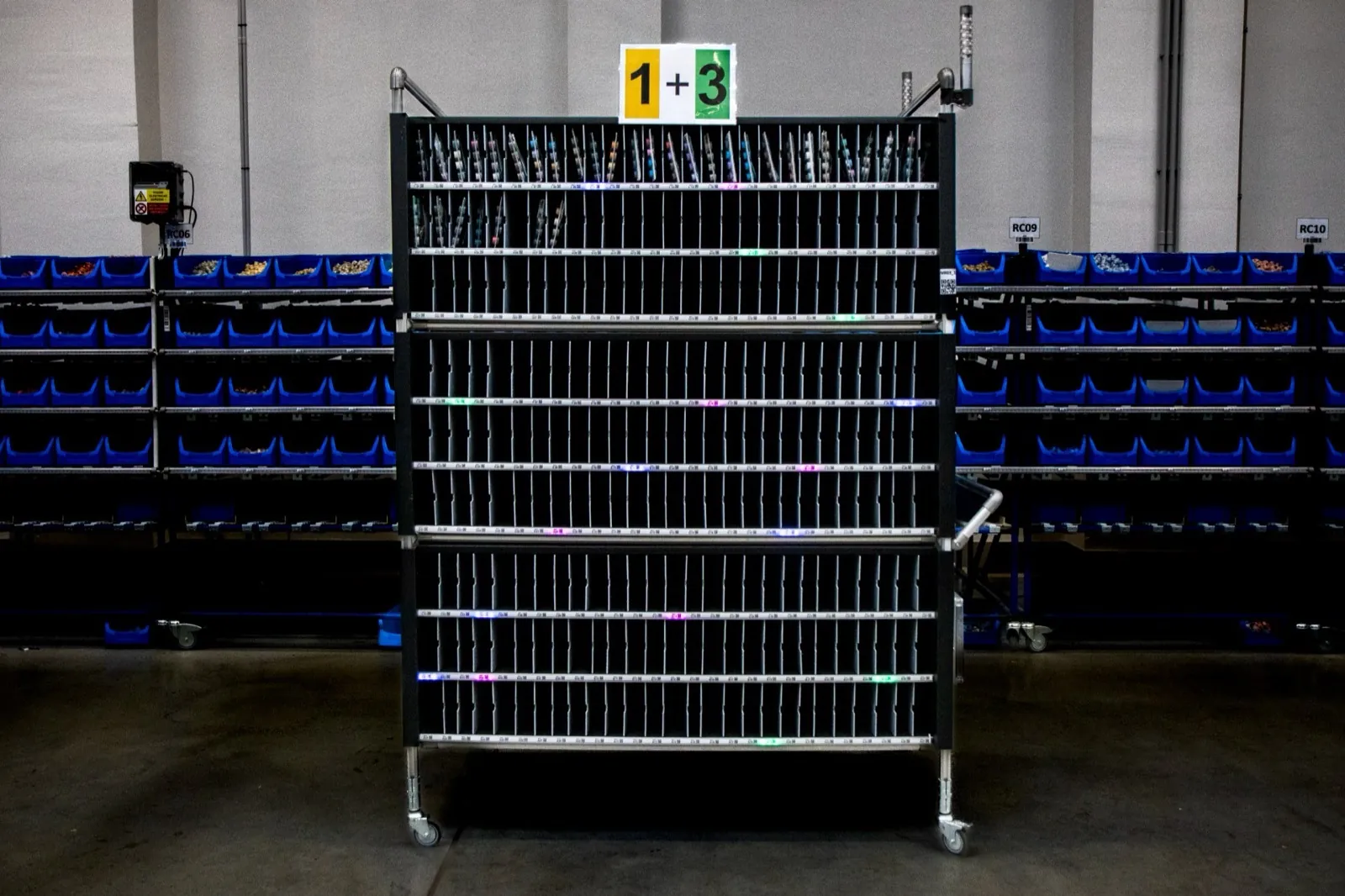
How light ensures the right kit and sequence
Location and quantity at a glance
The light marks the exact part location and an optional display shows the quantity, so swapping two similar variants in neighbouring bins becomes far less likely.
Several kits at once
Several kits can be built in parallel on a cart or at a shelf wall. Colour coding lets several people work at the same wall without confusion.
Model changes without rebuilds
With LED strips in profiles, positions are defined in software. A new part or layout after a model launch is a system change, not a hardware rebuild.
Linked to production control
The kit sequence comes from production control and every confirmation goes back, so logistics and production both see preparation status in real time.
How it works
- 1Production control sets the vehicle sequence and the resulting kits or part sequences.
- 2The system assigns each kit to a tote, a cart or a position in the sequence rack.
- 3Parts for the current kit light up on the shelf, including quantities.
- 4The picker takes and confirms the part, and the light moves to the next one in order.
- 5The finished kit goes to the line and the confirmation is sent to the host system.
WMS and ERP integration
Sequences and kit contents come from your WMS, ERP or production control system via REST API, MQTT or WebSocket. Each part confirmation returns in real time, showing which kit is complete and which is waiting. The CI4 control software can run locally, and for critical operations we offer redundant setups so a network outage does not stop kitting. We have developed both the hardware and the control software ourselves since 2018, so line-specific adjustments are handled at the source.
SoftwareWhat to prepare for an inquiry
- Number of variants and parts per kit or sequence
- Line takt time and required kits per shift
- Carrier type: totes, carts, sequence racks
- The system that supplies the production sequence
- Part dimensions and weights
Frequently asked questions
Other applications
All applications- E-commerce fulfillmentOne trip through the warehouse, several orders on one cart and a light that shows where each item belongs.Read more
- Put-to-light sortationPick in bulk, sort by light: a put wall splits one batch into dozens of orders at once.Read more
- Assembly guidanceError proofing for manual assembly: light leads the operator to the right part, step by step.Read more
Shall we look at your operation?
Send us your number of locations, orders and shifts – we will propose a setup and a payback estimate.