
Bulky parts on the floor: Flat Storage with rail tracks and LED navigation
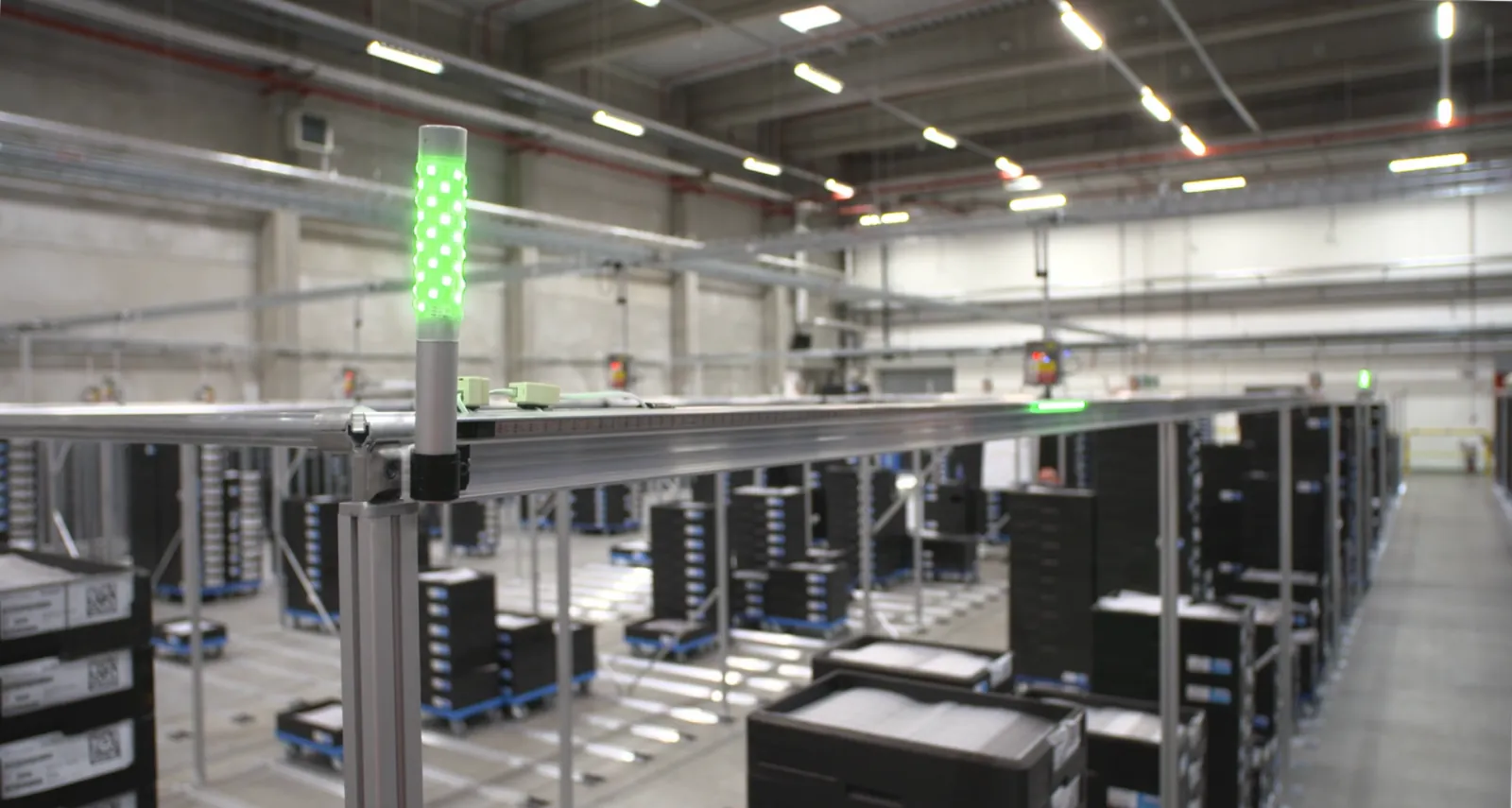
For bulky parts stored on the floor, Pick to Light in the form of Flat Storage guides operators by light to the right lane and container instead of leaving them to search rows of crates. Rail tracks keep containers in a fixed layout and LED gates show where to go. The same area holds up to 30% more, and picking bulky parts gets faster.
At a glance
- Up to 30% more capacity on the same floor area
- 3 hardware options: manual, P2L navigation, P2L + e-ink
- Flat Storage from our own P2L development, running since 2018
Why loose floor storage wastes space and time
Bulky parts and large containers do not fit standard racking, so they stand loose on the floor. Without a fixed layout, rows drift apart, unused gaps appear and operators have to read labels to find the right crate. In automotive and manufacturing these parts often go straight to the line, so every search delays supply.
What Flat Storage with LED navigation delivers
Rail tracks
Rails guide containers in precise rows, so the floor is used fully and every container has a clearly defined place.
LED navigation gates
Gates with LED strips above the lanes show which row to enter and which container to take. Operators follow the light, not labels.
Three equipment levels
From manual rails without electronics, through software-controlled light navigation, to e-ink displays showing exact quantities.
Proven at scale
At Witte Automotive, flat storage with LED navigation was part of a material flow redesign with 5,000 positions deployed in 6 weeks.
How it works
- 1A parts request arrives from the WMS, ERP or production control.
- 2The gate above the relevant lane lights up to mark the row.
- 3At the lane, a light or e-ink display shows the container and quantity.
- 4The operator confirms the pick and the next target lights up.
- 5The confirmation is written back to the host system in real time.
WMS and ERP integration
Gates and displays are driven by a controller connected over Wi-Fi or LAN, which talks to your WMS, ERP or production system via REST API or MQTT. With the manual option you can start with rails only and add light navigation later, without changing the floor layout.
SoftwareWhat to prepare for an inquiry
- Container or part dimensions and weights
- Available floor area and a floor plan
- Number of different parts and positions
- Desired equipment level (manual, navigation, e-ink)
- The system that issues requests
Frequently asked questions
Other applications
All applications- E-commerce fulfillmentOne trip through the warehouse, several orders on one cart and a light that shows where each item belongs.Read more
- Put-to-light sortationPick in bulk, sort by light: a put wall splits one batch into dozens of orders at once.Read more
- Automotive kittingEvery part into the right kit and in the right order, without leafing through variant lists.Read more
Shall we look at your operation?
Send us your number of locations, orders and shifts – we will propose a setup and a payback estimate.