
Most warehouses switch too late
Companies usually start looking at Pick to Light when the pain is already visible: complaints rise, temporary staff struggle, and supervisors spend the day solving exceptions.
But the better moment is earlier, when the warehouse is still working, just no longer comfortably.
Five signs the timing is right
1. Order volume is growing faster than team stability
If every peak means chaos, overtime and rushed onboarding, your process is no longer resilient.
2. Training depends too much on experienced people
When knowledge lives mainly in a few operators, every absence becomes a risk. Pick to Light replaces memory with visible instruction.
3. Errors are not dramatic individually, but expensive together
One wrong item may seem small. Repeated hundreds of times, it becomes customer friction, rework and margin loss.
4. Walking dominates the shift
If operators spend most of the day searching, crossing aisles or double-checking positions, the warehouse is paying for motion rather than throughput.
5. Your systems know what should happen, but the floor still struggles
This is one of the clearest indicators. If ERP or WMS logic is fine but execution remains slow, the missing layer is usually guidance.
Why Pick to Light is a strong first automation step
Compared with large-scale automation, Pick to Light has three commercial advantages:
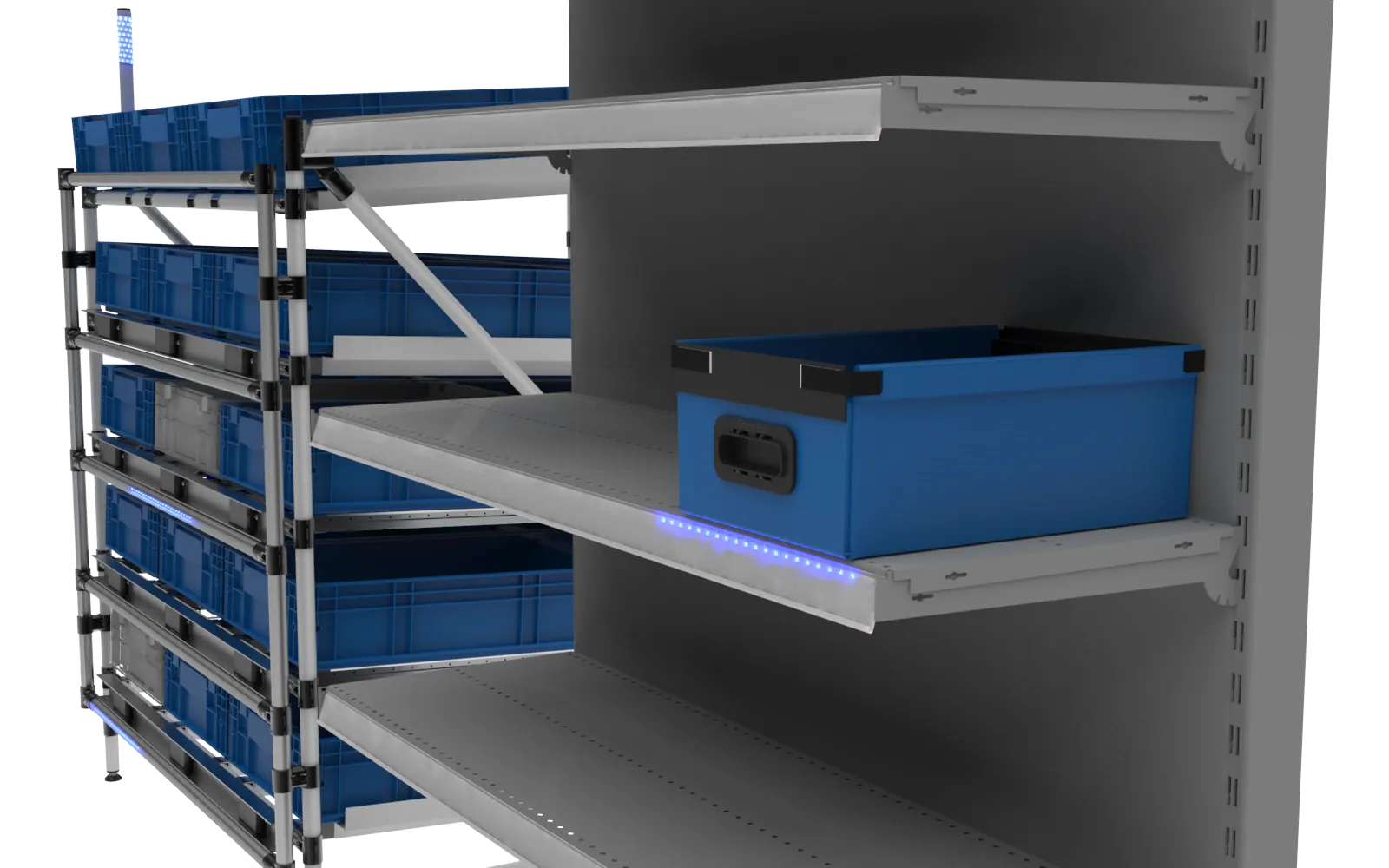
- it can often be added to existing shelves, carts and processes,
- the implementation risk is lower,
- the result is visible very quickly to both operators and managers.
That is why many companies use it as the first serious step before wider automation.
Where to start
- a fast-moving aisle,
- a kitting area,
- a replenishment zone,
- a cart-based picking process,
- a final sorting point.
The first project does not need to be large. It needs to be measurable.
Bottom line
Pick to Light is usually the right answer when the warehouse logic is good enough but human execution is becoming the bottleneck.
If that sounds familiar, the best next move is not another spreadsheet. It is a pilot in the zone where mistakes or walking hurt the most.