
The hidden cost in many warehouses
Many warehouses think they have a staffing problem. In reality they often have a routing problem.
If one picker walks ten kilometers per shift, the company is not mainly paying for picking. It is paying for movement between picks. That is expensive, hard to scale and frustrating for the team.
What multipicking changes
Instead of sending one person for one order, the system groups multiple orders into one route. The picker moves through the warehouse once and places items into several order boxes in parallel.
The goal is simple: reduce walking and increase useful touches.
When the route is well designed, the operator spends more time picking and less time traveling between locations. That changes labor productivity very quickly.
Why the method works
Multipicking combines three advantages:
- one route serves multiple orders,
- the algorithm minimizes duplicate visits to the same aisles,
- the picker receives exact instructions for quantity and destination box.
This is where many companies see a practical breakthrough. They do not necessarily need more people. They need a system that organizes the work better.
What strong implementations usually deliver
Based on publicly shared Logisio use cases, companies report outcomes such as:
- walking distance reduced by as much as 70 percent,
- picking productivity improved by 40 to 60 percent,
- savings of 1 to 3 FTE per shift,
- ROI measured in months rather than years.
These numbers are not a promise for every warehouse. But they are a strong indicator of what becomes possible once route logic is fixed.
Where Smartbox fits in
Multipicking gets even stronger when operators are supported visually.
For example:
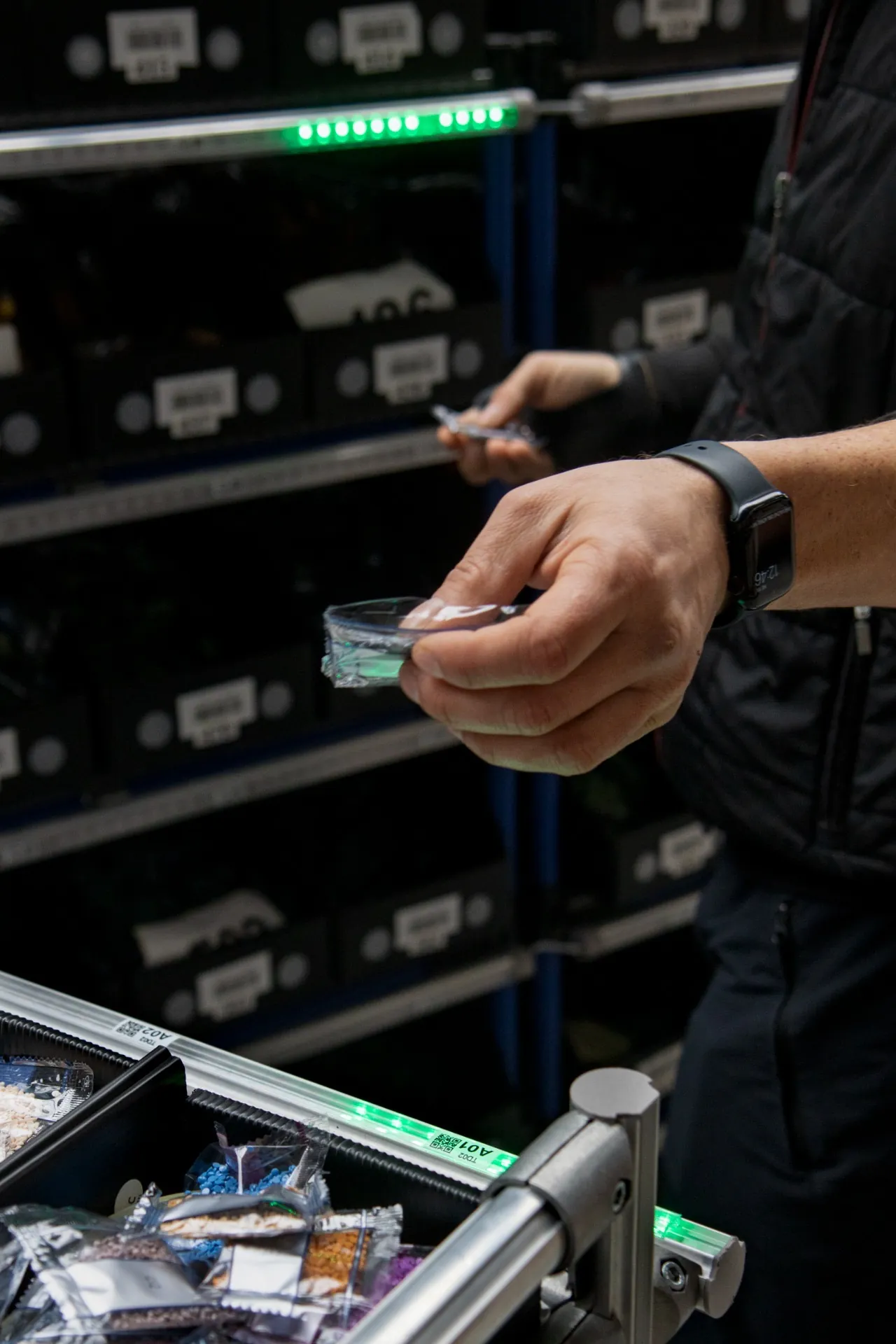
- mobile Pick to Light carts can split multiple orders in one pass,
- sortwall can handle fast final order distribution,
- shelf signaling can speed up confirmation at dense storage positions.
That is exactly why multipicking and Pick to Light are a powerful pair. One optimizes the route. The other simplifies the execution.
Questions worth answering before you start
- How many order lines does one picker process per shift today
- How much of the shift is actual picking versus walking
- Which SKUs repeat across many orders
- Whether the warehouse can batch similar orders together
If you can answer those questions, you can usually estimate the improvement very quickly.
Bottom line
The issue is often not that the warehouse lacks people. The issue is that too much of their time is spent moving without value.
Multipicking is one of the fastest ways to recover that lost capacity. And when combined with Smartbox Pick to Light, it becomes much easier to scale cleanly.